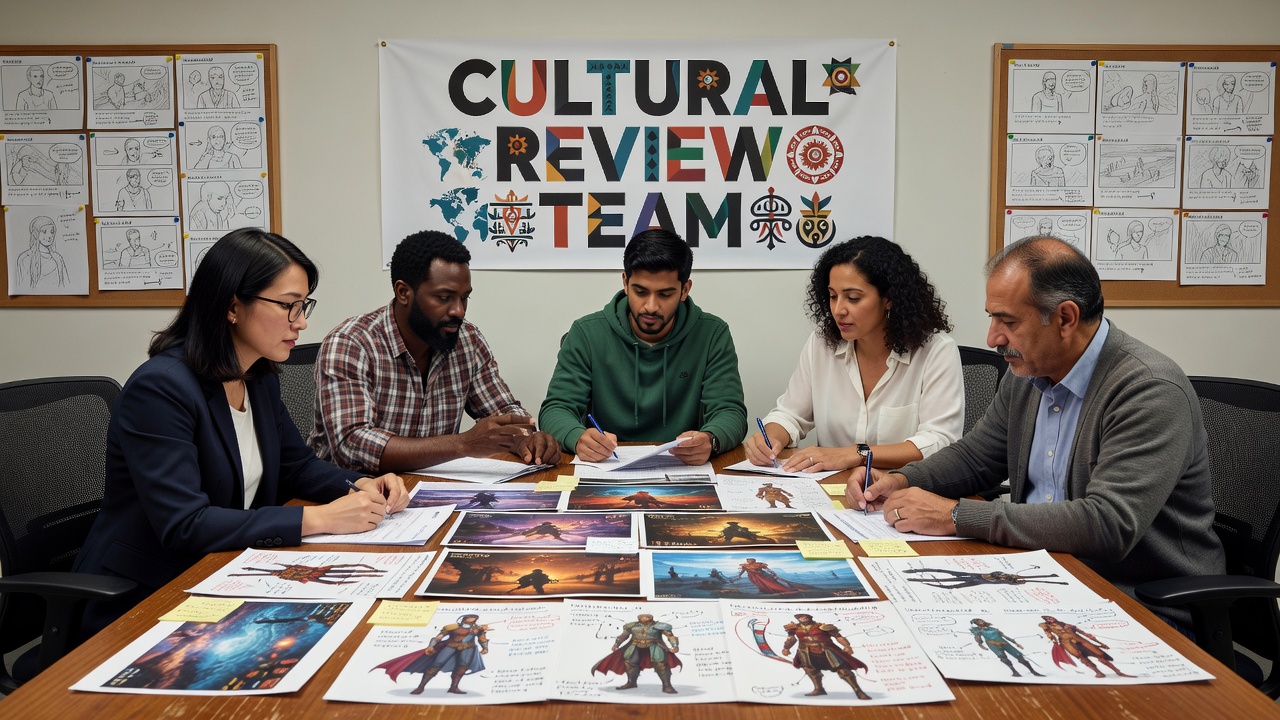
Translation, localization, culturalization
Translation moves words. Localization adapts the whole product, including formats, fonts, audio and interface. Culturalization, a term popularised in games by consultants such as Kate Edwards, goes one step further: it reviews the game's content, imagery and assumptions for meanings that a target audience might read differently, sometimes in ways that cause offence, legal trouble or a rating problem.
A cultural reviewer is often a native of the market with background in history, religion or local media, and not necessarily a translator. Their job is to flag risk and propose options; the decision to change content stays with the developer.
Symbols
Symbols carry history. Religious iconography, national flags, military insignia and political emblems are the obvious categories. Germany for decades treated unconstitutional symbols in games very strictly, which led to altered releases of several World War II titles; in 2018 the USK rating body began assessing such content case by case under a "social adequacy" clause. Reviewers must know the current rule, not last decade's.
Less obvious symbols matter too. The red cross emblem is protected under the Geneva Conventions, and its use on in-game medical kits has led several studios to replace it with green crosses or hearts. Numbers carry associations: four sounds like the word for death in Chinese, Japanese and Korean, while thirteen worries some Western players. Skulls and skeletons have historically been a sensitivity for releases in mainland China, and many studios have adjusted art for that market.
Gestures and body language
Character animation communicates without words, so it slips past linguistic testers. A thumbs-up, the "OK" circle, a beckoning finger, showing the sole of a shoe, or a V-sign with the palm inward can each read as rude somewhere. Emotes and victory poses in multiplayer games deserve special attention because players use them deliberately at each other.
Colour, food and daily life
White is associated with mourning in parts of East Asia; red signals luck and celebration in China but danger or loss in other contexts. Food items, alcohol, pork and gambling mechanics can be sensitive in some markets and age-rating triggers in others. None of these is a universal rule, which is exactly why reviewers work from market-specific notes rather than a single global list.
Maps, borders and history
Maps are one of the highest-risk assets in any game. A border line, a place name or a coloured territory can contradict the official position of a government, and games have been refused distribution or patched after release for this reason. Reviewers check world maps, flags in multiplayer menus, and historical scenarios that describe real conflicts. Where a neutral solution is impossible, teams sometimes use fictional geography.
Names, humour and wordplay
Character names can mean something unintended in another language, from an accidental insult to a brand name. Puns rarely survive; good localization replaces them rather than explaining them. The Pokémon series is a well-known example of systematic adaptation, with creature names reinvented for many languages so that the wordplay works locally. Testers confirm that renamed items stay consistent across dialogue, UI, achievements and store pages.
Gaps: what is missing
Cultural review also looks for absences. A calendar event built around Thanksgiving means little in Finland. A tutorial that assumes left-to-right reading order confuses Arabic and Hebrew players. A name-entry field that rejects accented letters tells French and Vietnamese players the game was not made for them. Gaps are rarely offensive, but they make a game feel foreign.
Ratings boards are part of culture
Age-rating systems reflect local values: PEGI across most of Europe, ESRB in North America, USK in Germany, CERO in Japan, GRAC in South Korea and ClassInd in Brazil, with IARC handling many digital storefronts. The same blood effect or gambling mechanic can earn different ratings, so cultural notes and rating submissions should be prepared together.